Spring Collective

WEST HEALTH ROAD SuDS REPORT AND FRA

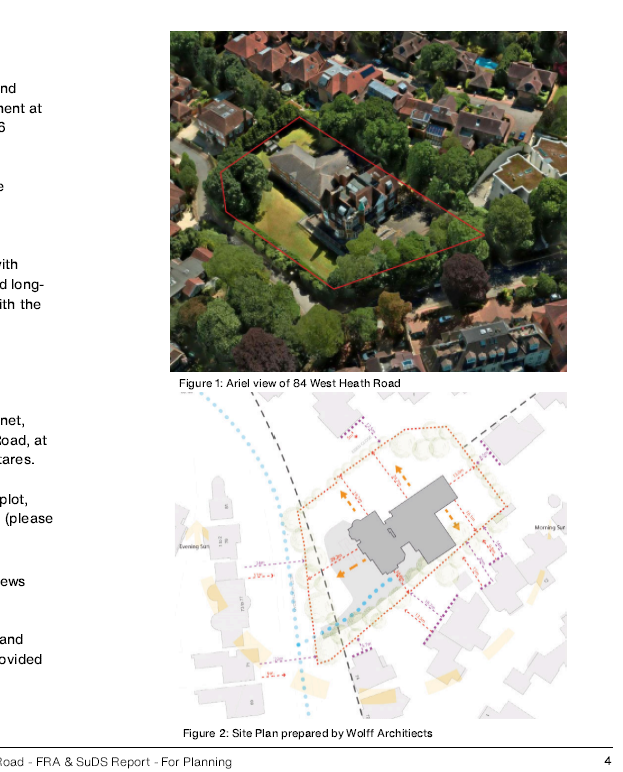
At 84 West Heath Road in Barnet, Spring Collective worked with the developer and landscape architect to design a drainage and flood resilience strategy that sits quietly beneath the surface — but plays a vital role in shaping a sustainable, climate-ready building.

The project supports the redevelopment of the site into 56 high-quality residential care units, bringing new life to an established residential setting while ensuring that water is managed with care, efficiency, and long-term resilience.

The brief was to make the development safe and sustainable for its lifetime, while meeting strict national and local planning policies on flood risk and water management. Our role was to prepare a Flood Risk Assessment (FRA) and Sustainable Drainage Strategy (SuDS) to demonstrate that the site — located within the River Brent catchment — would remain secure in all conditions, and that surface water could be managed on-site without increasing flood risk elsewhere.


Key Outcomes

Fully compliant flood risk assessment and drainage strategy supporting successful planning approval Climate-resilient SuDS design managing a 1-in-100-year storm plus 45% climate change.

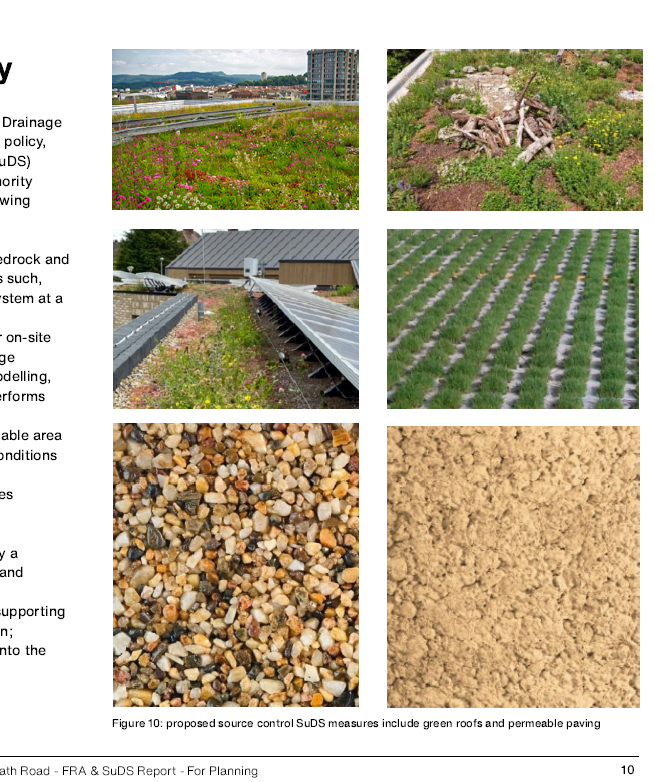
Water managed sustainably at source through green roofs, permeable paving and rainwater harvesting.

Runoff limited to greenfield rate (2.2 l/s) with on-site attenuation and flow control.

Enhanced site safety and resilience through clear exceedance routing and robust modelling.


Starting with desk-based studies and mapping from the Environment Agency, British Geological Survey, and Thames Water, we assessed every potential source of flooding — from rivers and sewers to groundwater and surface runoff.

The results were reassuring: the site sits entirely within Flood Zone 1, the lowest category of flood risk. That gave us the foundation to focus on making the design climate-resilient — capable of handling more intense rainfall events expected in the coming decades. We modelled rainfall scenarios using InfoDrainage software, designing a SuDS system that can manage the 1-in-100-year storm event plus a 45% climate change allowance.


“Spring Collective worked diligently to secure full planning permission for the development. They were responsive, highly informed on local policy, and collaborated seamlessly with the design and landscape teams — even suggesting landscape refinements that ultimately strengthened the overall scheme.

Anil, Harrison Varma 

Partners + Collaborators

Harrison Varma
Wolff Architects
Hgh Consulting

We followed the drainage hierarchy, managing water as close to its source as possible. The final strategy includes: Extensive green roofs to intercept and slow rainfall at source. Permeable paving across parking and courtyard areas, filtering and storing rainwater within the sub-base. Rainwater harvesting tanks for landscape irrigation. Exceedance routing, ensuring that even during extreme rainfall, surface water safely flows away from buildings and thresholds. Together, these features form a layered, resilient system that keeps the site dry, manages water quality, and contributes to urban greening.